|Table of Contents|
|
|
1. Can Farmland Transfers Be Exempt from Land Value Increment Tax?
-
Article 37, Paragraph 1 of the Agricultural Development Act provides that when agricultural land used for agricultural purposes is transferred to a natural person, an application may be filed for non-imposition of land value increment tax.
-
Farmland eligible for non-imposition of land value increment tax must be used for agricultural purposes and may only be transferred to a natural person.
-
Relevant proof must be submitted to show that the agricultural land is actually used for agricultural purposes. It should be noted that farmland approved for non-imposition of land value increment tax must continue to be used for agricultural purposes. If it is no longer used for agricultural purposes, land value increment tax will have to be paid upon the next transfer.
-
-
Two Key Requirements for Non-Imposition of Land Value Increment Tax on Farmland Transfers:
-
The agricultural land must be “used for agricultural purposes.”
-
The land must be transferred to a “natural person.”
-
How to Apply for Non-Imposition of Land Value Increment Tax on Farmland
-
The applicant must first apply to the competent agricultural authority where the land is located for a “Certificate of Agricultural Land Used for Agricultural Purposes.”
-
After obtaining the Certificate of Agricultural Land Used for Agricultural Purposes, the applicant may attach the certificate and apply for non-imposition of land value increment tax.
-
Friendly Reminder:
-
The Certificate of Agricultural Land Used for Agricultural Purposes is valid for six months. When declaring the current land value for transfer, make sure the certificate is still within its validity period.
-
A land value increment tax payable amount of NT$0 cannot replace a “Certificate of Non-Imposition of Land Value Increment Tax.”
-
.png)
▲Certificate of Agricultural Land Used for Agricultural Purposes, application purpose: non-imposition of land value increment tax.
.png)
▲Application for Non-Imposition of Land Value Increment Tax, with the Certificate of Agricultural Land Used for Agricultural Purposes attached
2. Can Farmland Transfers Be Exempt from House and Land Transactions Income Tax?
-
Article 4-5, Paragraph 1, Subparagraph 2 of the Income Tax Act provides that land acquired on or after January 1, 2016 that qualifies for application for non-imposition of land value increment tax under Articles 37 and 38-1 of the Agricultural Development Act is exempt from income tax.
- Article 37, Paragraph 1 of the Agricultural Development Act provides that when agricultural land used for agricultural purposes is transferred to a natural person, an application may be filed for non-imposition of land value increment tax.
- Article 38-1 of the Agricultural Development Act provides that if agricultural land has been legally changed to non-agricultural land, but is recognized by the urban planning authority and the landowner obtains a certificate issued by the competent agricultural authority proving that the land is used for agricultural purposes, the land may qualify for non-imposition of land value increment tax or exemption from estate tax and gift tax.
- Only when land acquired on or after January 1, 2016 is “agricultural land used for agricultural purposes” or land “deemed agricultural land,” and is transferred to a natural person, can it meet the requirements for applying for non-imposition of land value increment tax.
- If agricultural land has been legally changed to non-agricultural land, but meets the relevant requirements, the land may be “deemed agricultural land.” After obtaining a certificate proving that the land is used for agricultural purposes, the applicant may apply for non-imposition of land value increment tax.
- When land that meets the requirements for non-imposition of land value increment tax is transferred, the income from the land is exempt from house and land transactions income tax.
- How Can Farmland Apply for Exemption from House and Land Transactions Income Tax?
- The applicant must first apply to the competent agricultural authority where the land is located for a “Certificate of Land Used for Agricultural Purposes under Article 38-1 of the Agricultural Development Act.”
- After obtaining the certificate above, the applicant should attach the certificate and apply for non-imposition of land value increment tax.
- After obtaining the “Certificate of Non-Imposition of Land Value Increment Tax,” the applicant should attach both the “Certificate of Land Used for Agricultural Purposes under Article 38-1 of the Agricultural Development Act” and the “Certificate of Non-Imposition of Land Value Increment Tax” to apply for exemption from house and land transactions income tax.
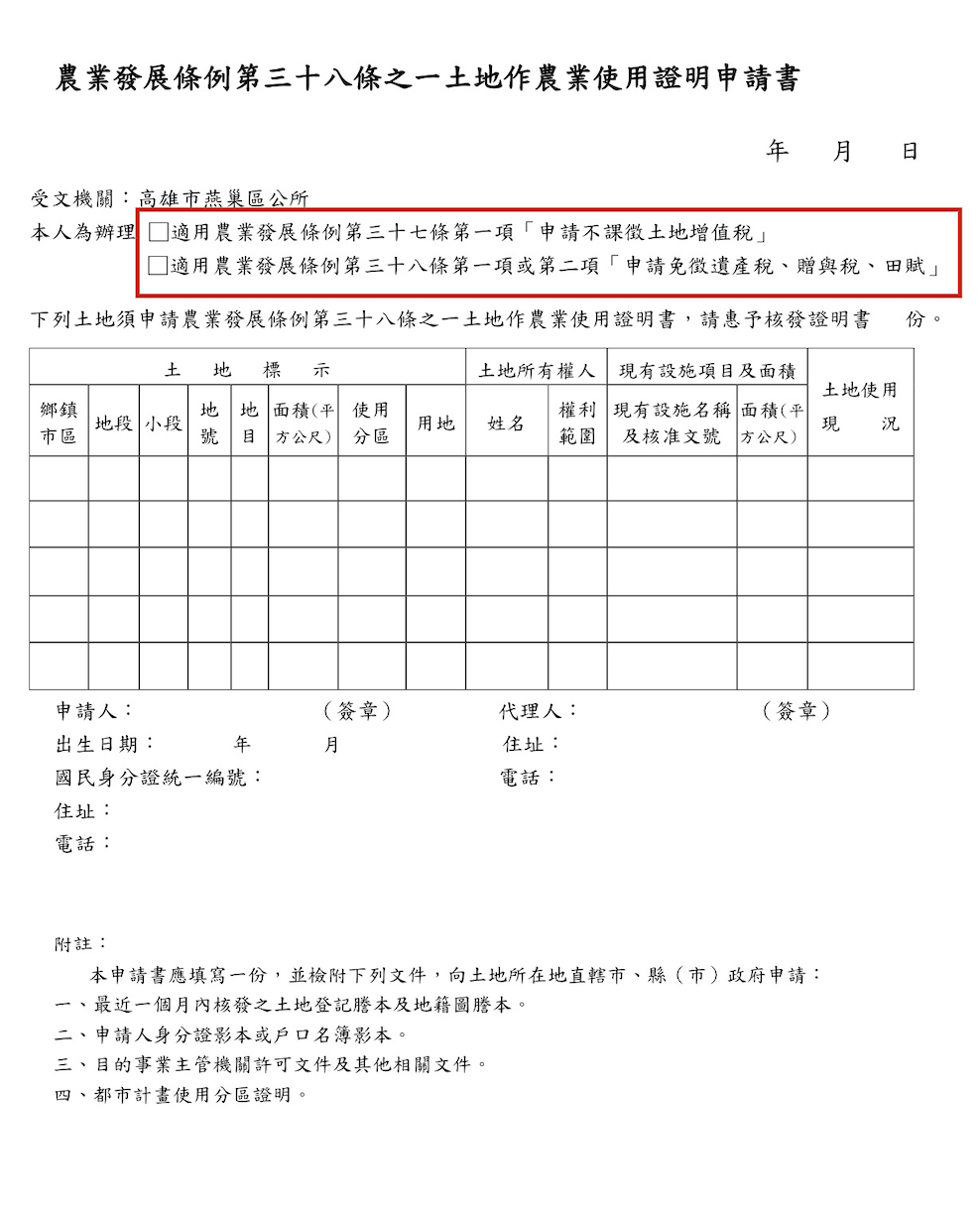
▲Application for Certificate of Land Used for Agricultural Purposes under Article 38-1 of the Agricultural Development Act
3. Can Gift Transfers of Farmland Be Exempt from Gift Tax?
-
Article 20 of the Estate and Gift Tax Act provides that when agricultural land used for agricultural purposes, together with the crops on the land, is gifted to an heir specified under Article 1138 of the Civil Code, the value of the land and the crops on it shall not be included in the total amount of gifts.
-
Article 38, Paragraph 2 of the Agricultural Development Act provides that when agricultural land used for agricultural purposes, together with the crops on the land, is gifted to an heir specified under Article 1138 of the Civil Code, the value of the land and the crops on it is exempt from gift tax. The recipient must continue to use the land for agricultural purposes for five years from the date of the gift.
-
For a gift transfer of farmland to qualify for gift tax exemption, the recipient is limited to lineal descendants by blood, parents, siblings, or grandparents.
-
It is also important to note that within five years from the date of the gift, the recipient must continue to use the farmland for agricultural purposes. If the land is not used for agricultural purposes, such as where the farmland is sold, the National Taxation Bureau will collect the gift tax payable from the donor.
-
When applying for gift tax exemption, the “Certificate of Agricultural Land Used for Agricultural Purposes” must be attached.
-
Two Key Requirements for Gift Tax Exemption on Agricultural Land:
-
The recipient must be limited to an heir specified under Article 1138 of the Civil Code.
-
The recipient must continue to use the land for agricultural purposes for five years from the date of the gift. For example, the land may not be sold during the five-year monitoring period.
| Heirs Specified Under Article 1138 of the Civil Code | ||
|---|---|---|
| Order | Relationship | Notes |
| First Order | Lineal descendants by blood | Including children, grandchildren, great-grandchildren, and so on. |
| Second Order | Parents | Including biological parents and adoptive parents. |
| Third Order | Siblings | Including full siblings, paternal half-siblings, maternal half-siblings, and adopted siblings. |
| Fourth Order | Grandparents |
Including paternal and maternal grandparents, namely grandfather, grandmother, maternal grandfather, and maternal grandmother. |
4. Can Inherited Farmland Be Exempt from Estate Tax?
-
Article 17, Paragraph 6 of the Estate and Gift Tax Act provides that when agricultural land used for agricultural purposes, together with the crops on the land, is included in an estate and is acquired by an heir or legatee, the value of the land and the crops on it may be deducted from the total estate and exempted from estate tax.
-
Article 38, Paragraph 1 of the Agricultural Development Act provides that when agricultural land used for agricultural purposes, together with the crops on the land, is acquired by an heir or legatee, the value of the land and the crops on it is exempt from estate tax. The person acquiring the land must continue to use it for agricultural purposes for five years from the date of acquisition.
-
Under the relevant laws, agricultural land acquired by “inheritance” or as a “legacy” may be exempt from estate tax. However, the condition is that the heir or legatee must continue to use the land for agricultural purposes for five years from the date of acquisition.
-
If the heir or legatee fails to continue using the agricultural land for agricultural purposes during this five-year period, the National Taxation Bureau will collect the estate tax payable.
-
When applying for estate tax exemption, the “Certificate of Agricultural Land Used for Agricultural Purposes” must be attached.
-
Two Key Requirements for Estate Tax Exemption on Agricultural Land:
-
The land must be acquired by “inheritance” or as a “legacy.”
-
The heir or legatee must continue to use the land for agricultural purposes for five years from the date of acquisition. For example, the land may not be sold during the five-year monitoring period.
.png)
▲Certificate of Agricultural Land Used for Agricultural Purposes, application purpose: estate tax exemption.
5. Comparison of Tax Reductions and Exemptions for Farmland Transfers
|
Comparison of Tax Reductions and Exemptions for Farmland Used for Agricultural Purposes
|
||||
|---|---|---|---|---|
|
|
Land Value Increment Tax
|
Gift Tax
|
Estate Tax
|
House and Land Transactions Income Tax
|
|
Requirements
|
The land must be transferred to a natural person.
|
The recipient is limited to an heir specified under Article 1138 of the Civil Code.
|
The land must be acquired by “inheritance” or as a “legacy.”
|
The land must meet the requirements for non-imposition of land value increment tax.
|
|
Supporting Documents
|
Certificate of Agricultural Land Used for Agricultural Purposes
|
|
||
|
Restrictions
|
The land must continue to be used for agricultural purposes.
|
The land must continue to be used for agricultural purposes during the five-year monitoring period.
|
The land must continue to be used for agricultural purposes during the five-year monitoring period.
|
The land must continue to be used for agricultural purposes.
|
Further Reading: Self-Use Residential Land Value Increment Tax Rate in Taiwan: Requirements for Once in a Lifetime and One House per Lifetime
【全謹代書事務所社群上線啦!】
看文章卻覺得字太多、太複雜嗎?
快來追蹤【全謹代書事務所】官方
FB、IG、YouTube、TikTok(抖音)、小紅書
想看簡單易懂的圖文,或是想透過生動活潑的短影音學習知識,官方社群都能滿足你!
看文章卻覺得字太多、太複雜嗎?
快來追蹤【全謹代書事務所】官方
FB、IG、YouTube、TikTok(抖音)、小紅書
想看簡單易懂的圖文,或是想透過生動活潑的短影音學習知識,官方社群都能滿足你!
▲點擊進入【全謹代書事務所】官方FB帳號

▲點擊進入【全謹代書事務所】官方IG帳號
(1).png)

.png)