1. Can a House Be Transferred Before the Loan Is Paid Off?
-
Yes. A mortgage does not prevent the transfer of ownership, including transfers by sale, gift, or inheritance. Therefore, even if there is an outstanding loan on the house, the house can still be transferred to another person.
-
A bank mortgage loan agreement usually does not state that the property cannot be transferred before the loan is fully repaid. The clause on “restrictions on disposition of the collateral” generally applies only to acts such as remodeling, demolition, construction, addition, or other acts that may reduce the value of the house. The term “disposition” here does not include ownership transfers such as gifts or sales.
-
The main purpose of this restriction is to prevent the value of the house from being reduced by such acts, so that if the borrower later fails to repay the loan and the bank enforces the mortgage through a court auction, the auction price will not be insufficient to cover the debt. Therefore, this type of restriction on the mortgaged house is unrelated to the transfer of ownership.
2. Can a House with an Existing Mortgage Be Transferred to a Spouse, Child, or Parent?
-
Yes. Article 867 of the Civil Code provides: “After the owner of real property has created a mortgage, the owner may transfer the real property to another person. However, the mortgage shall not be affected thereby.”
-
In other words, real property with a registered mortgage may still be transferred to another person even before the mortgage is cancelled. After the ownership transfer, the mortgage will remain on the property. It does not matter if the borrower and the property owner are different people. This rule is intended to protect the creditor’s rights.
-
Therefore, a mortgage on a house does not prevent an ownership transfer. The house may still be transferred to a spouse, child, parent, or third party.
-
However, if the real property is subject to an “advance notice registration,” it cannot be transferred to anyone other than the person holding the claim under the advance notice registration unless the registration is cancelled first.
-
Gift Transfer of Real Property to a Spouse
-
A husband purchased a house with a mortgage loan. Because he loves his wife, he decides to gift the house to her. Even if the mortgage has not been fully paid off at the time of the gift, the house can still be transferred to the wife by gift. The wife becomes the owner, while the husband remains the borrower under the mortgage loan and continues to be responsible for the monthly repayments.
-
Article 20 of the Estate and Gift Tax Act provides: “Property gifted between spouses shall not be included in the total amount of gifts.”
-
However, the husband as the donor must still file a gift tax return and obtain a “Certificate of Exclusion from Total Amount of Gifts” from the National Taxation Bureau before applying for the gift transfer registration at the land office.
-
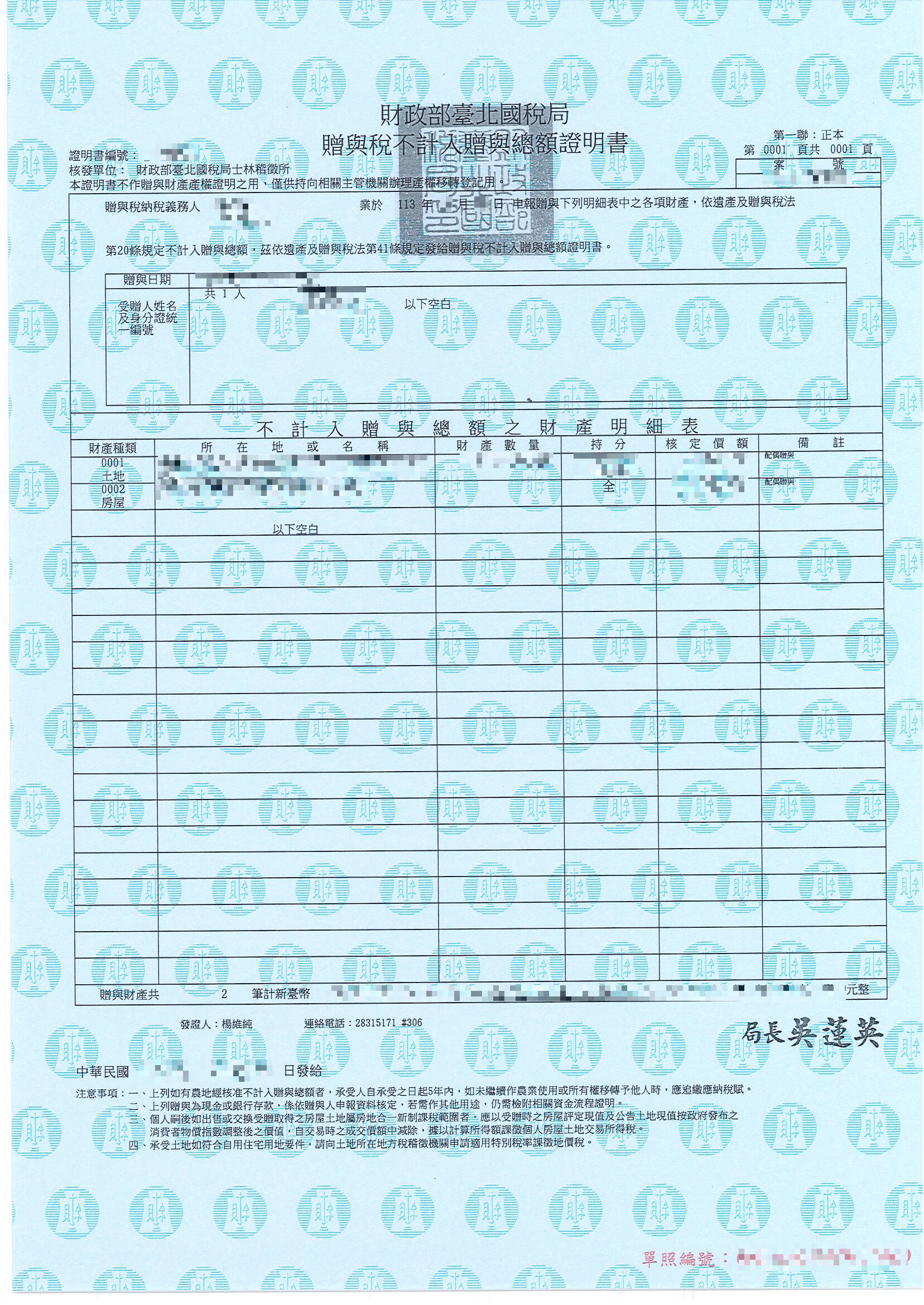
►Example: Certificate of Exclusion from Total Amount of Gifts
-
Gift Transfer of Real Property to Children or Younger Relatives
-
In practice, parents may transfer real property by gift in advance to minor children, children who are not yet employed or do not yet have repayment ability, or younger relatives such as nieces and nephews.
-
Whether the property is subject to the parents’ original home purchase mortgage or an additional mortgage loan, it may still be transferred by gift before the loan is fully repaid.
-
After the gift transfer, the parents remain the borrowers under the mortgage loan. This will not be affected by the ownership transfer by gift.
-
Even if the parents’ annual repayments on the mortgage later exceed NT$2.44 million, gift tax will not arise, because the parents are the borrowers repaying their own mortgage loan. This does not involve a gift at all.
-
.png)
►Case Study: Gift Transfer of a Mortgaged House Between Spouses
3. Can Children Use Their Parents’ House as Collateral for a Loan?
-
Yes. Mortgage loans from financial institutions do not require the borrower and the property owner to be the same person. As long as the property owner, namely the parents, agrees, another person, such as the child, may be the borrower.
-
In this situation, the financial institution may require the property owner to act as a general guarantor for the mortgage loan. However, if the borrower has strong enough financial qualifications, the bank may not require a general guarantor and may only require the property owner to act as the collateral provider.
-
General guarantor: If the borrower fails to repay the loan, the financial institution may demand repayment from the general guarantor. If the mortgaged real property is sold through a court auction and the proceeds are still insufficient to repay the mortgage, the general guarantor remains liable for the shortfall.
-
Collateral provider: Also known as a “real surety,” this refers to a person who provides their own property as mortgage collateral to the creditor but does not assume any personal guarantee obligation for the debt. If the debtor fails to repay the loan, the financial institution may only enforce against the mortgaged real property through a court auction. Even if the auction proceeds are insufficient to fully repay the debt, the collateral provider does not have to repay the shortfall.
-
-
Please note that although the property owner has no repayment obligation, if the borrower fails to repay the loan on time, the bank may still enforce the mortgage and auction the property.
-
Therefore, as long as the parents are willing, the child may obtain the parents’ consent to mortgage the house under the parents’ name to the bank in order to apply for a loan.
-
When the child applies for the loan, the parents must sign the relevant documents together. This is to confirm that they agree to provide the house as collateral for the child’s bank loan.
4. Transferring Property to Children Through a Sale
-
If the parents, as the sellers, still have an outstanding mortgage, the child, as the buyer, may complete the sale and ownership transfer process without paying off the seller’s existing loan, as long as the child is able to pay the full purchase price in cash, at least equal to the total publicly announced current land value plus the assessed present value of the house.
-
The following two examples explain whether the seller’s mortgage will be paid off in different cases:
-
Xiao Ming owns an apartment in Tianmu with a market value of NT$20 million, and there is still an outstanding mortgage of NT$16 million. He agrees to sell the apartment to his son for NT$10 million, which is the total publicly announced current land value plus the assessed present value of the house. His son plans to pay the full NT$10 million in cash from savings and chooses not to apply for a loan. The sale contract also provides that after the ownership transfer, Xiao Ming does not have to repay the NT$16 million mortgage in full at once.
-
Advantage: Because current mortgage interest rates are low, Xiao Ming does not need to rush to repay the mortgage. He can make better use of the NT$10 million funds for other investments and potentially generate better returns.
-
Disadvantage: If Xiao Ming’s son needs funds in the future and wants to apply for a mortgage loan, but Xiao Ming’s original loan has not yet been repaid, the son may first need to ask his father to partially or fully repay the mortgage. If Xiao Ming is unable or unwilling to cooperate at that time, the son may be placed in a passive position.
-
-
Mr. Lee owns a building in Luzhou with a market value of approximately NT$30 million, and there is currently an outstanding mortgage of NT$15 million. He now plans to sell it to his daughter for NT$20 million, which is higher than the total publicly announced current land value plus the assessed present value of the house. His daughter has a down payment of NT$4 million and applies to the bank for a loan of NT$16 million. Under the general real estate transaction process, when the bank disburses the mortgage loan, it will first repay Mr. Lee’s existing mortgage, and the remaining amount will then be transferred into Mr. Lee’s account. Therefore, Mr. Lee’s loan will be paid off first during the transaction process. The overall process is no different from a normal sale and purchase transaction in the general market.
-
Pros and Cons of Ownership Transfer by Sale
-
Advantages:
-
There may be an opportunity to apply the self-use residential land value increment tax rate, under the once-in-a-lifetime rule or the one-house-per-lifetime rule. By contrast, for a gift transfer, even if the property is actually used for self-use residential purposes, the law provides that as long as the transfer is made by gift, land value increment tax can only be calculated at the general tax rate.
-
The sale price may be set higher, which may create an opportunity to reduce or avoid house and land transactions income tax when the property is sold in the future.
-
There may be an opportunity to apply for a repurchase tax refund for land value increment tax and house and land transactions income tax.
-
-
Disadvantages:
-
The buyer must actually pay the purchase price, either by providing a down payment or by applying for a loan.
-
If the transaction involves a sale between relatives within the second degree of kinship, including relatives by blood and relatives by marriage, the buyer’s source of funds and loan repayment ability will also be subject to review by the National Taxation Bureau.
-
-
【全謹代書事務所社群上線啦!】
看文章卻覺得字太多、太複雜嗎?
快來追蹤【全謹代書事務所】官方
FB、IG、YouTube、TikTok(抖音)、小紅書
想看簡單易懂的圖文,或是想透過生動活潑的短影音學習知識,官方社群都能滿足你!
看文章卻覺得字太多、太複雜嗎?
快來追蹤【全謹代書事務所】官方
FB、IG、YouTube、TikTok(抖音)、小紅書
想看簡單易懂的圖文,或是想透過生動活潑的短影音學習知識,官方社群都能滿足你!
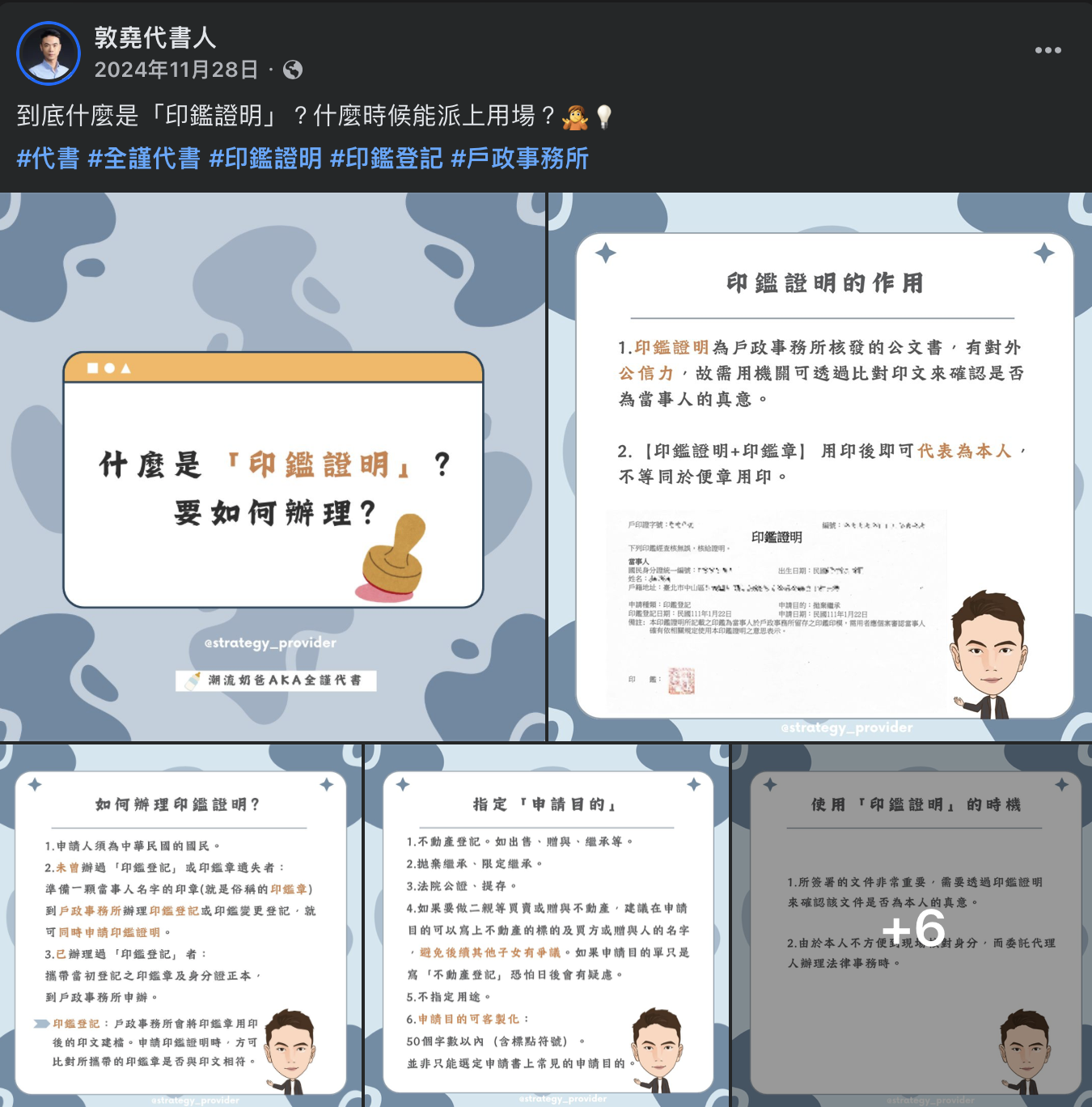
▲點擊進入【全謹代書事務所】官方FB帳號

▲點擊進入【全謹代書事務所】官方IG帳號
(1).png)
.png)