- Since the house and land transactions income tax system, which taxes transactions based on actual transaction value, took effect on January 1, 2016, gratuitous transfers of real estate between relatives or friends are no longer commonly handled only through gift transfers as they often were before January 1, 2016, assuming the original owner cannot apply the self-use residential land value increment tax rate or does not want to use that opportunity for this transfer.
- This is because the acquisition cost of gifted real estate is calculated based on the “publicly announced current land value” plus the “assessed present value of the house.” When the property is later sold to a third party, it will usually be sold at market value. The difference between the market value and the acquisition cost at the time of the gift may be large, causing the National Taxation Bureau to treat the gain as substantial when house and land transactions income tax is filed, which may result in a high tax burden.
- Therefore, in current practice, there are many cases that are structured as a sale in name but are essentially a gift in substance. The purpose is to prevent the new owner from potentially having to pay a high amount of house and land transactions income tax when selling the property in the future.
- Of course, many people choose a sale mainly because they want to apply the once-in-a-lifetime self-use residential land value increment tax rate, while also considering the house and land transactions income tax that may arise upon a future sale.
Note: In principle, the “publicly announced current land value” plus the “assessed present value of the house” is far lower than the market value.
-
Because the acquisition cost of a gift transfer is calculated based on the “publicly announced current land value” plus the “assessed present value of the house.” If the property is later sold to a third party, it will usually be sold at market value, which may create a risk of high house and land transactions income tax.
-
A sale is the only method that may allow the self-use residential land value increment tax rate to apply. By contrast, a gift transfer can only be taxed at the general land value increment tax rate, regardless of whether the property is currently treated as self-use for house tax or land value tax purposes.
- If the “publicly announced current land value” plus the “assessed present value of the house” exceeds the gift tax exemption of NT$2.44 million, and the parties do not want to split the gift over multiple years, using a sale to transfer the property in one transaction may also avoid gift tax.
2. When Might a Gift Transfer Be Chosen?
-
The publicly announced current land value plus the assessed present value of the house is less than the gift tax exemption of NT$2.44 million, and land value increment tax and future house and land transactions income tax are not being considered.
-
Although the publicly announced current land value plus the assessed present value of the house exceeds the gift tax exemption of NT$2.44 million, if the new owner does not have sufficient funds or the ability to obtain a loan to pay the amount exceeding NT$2.44 million, the parties may choose installment gifts over several years or a one-time gift with gift tax paid.
- This situation is more common when the new owner does not have sufficient funds, or cannot obtain a mortgage loan from a bank due to lack of employment or repayment ability.
- The original owner has not held the real estate for a long period, so the difference between the self-use residential rate and the general rate for land value increment tax is not significant.
- The original owner does not meet the requirements for applying the once-in-a-lifetime rule or the one-house-per-lifetime rule for the self-use residential land value increment tax rate. As a result, even if the transfer is structured as a sale, only the general land value increment tax rate can apply.
- The transferred property is co-owned property, namely a share, and the buyer is not a co-owner, so there may be concern that other co-owners will exercise their right of first refusal.
3. Why Can a Sale Be Completed Without a Down Payment or Full Purchase Price, and What Are the Requirements?
-
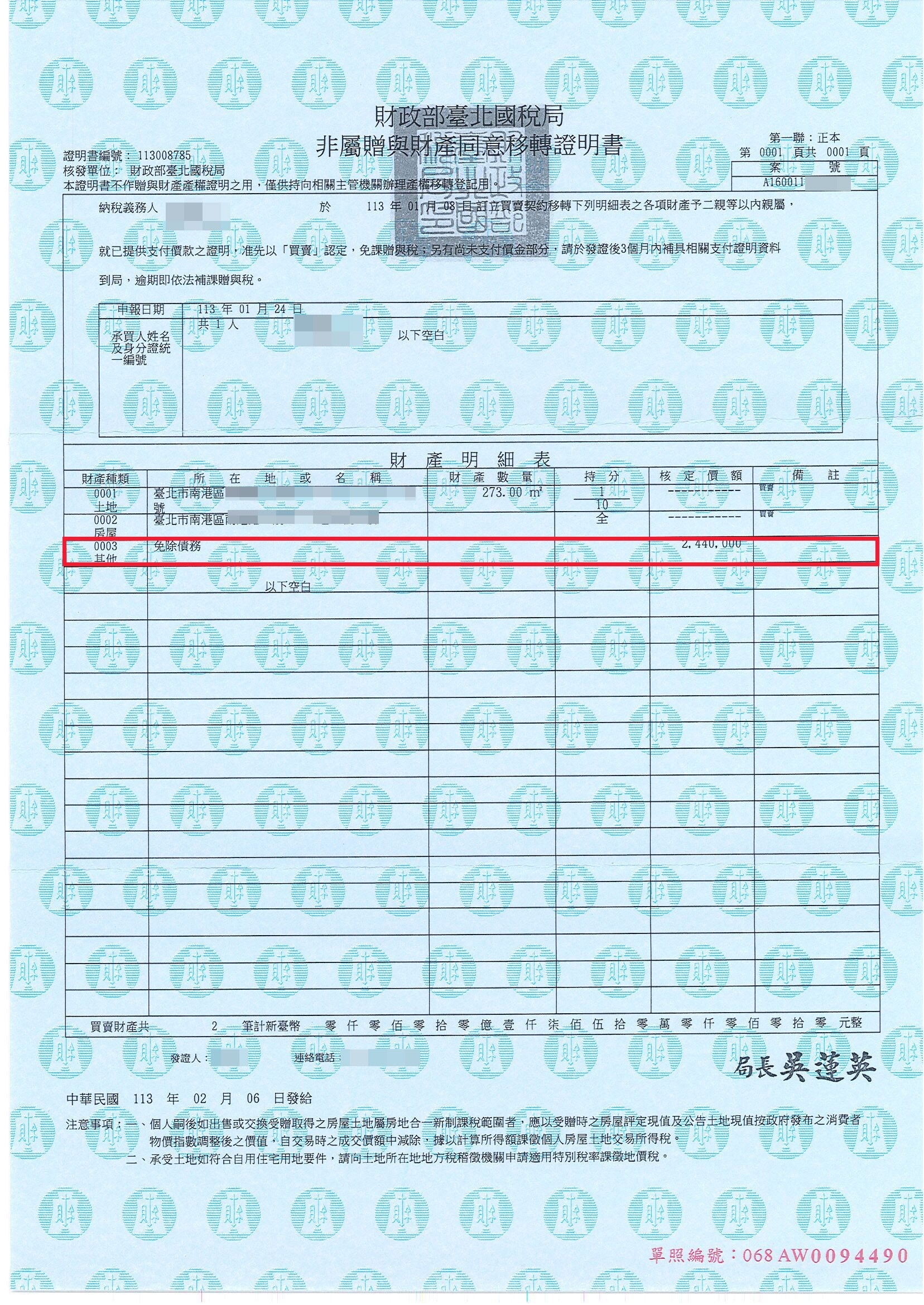
The key is that the sale contract may directly specify how much of the purchase price the seller agrees to waive for the buyer.
-
Under this arrangement, the seller is gratuitously releasing another person from a debt, which is treated as a gift under Article 5, Subparagraph 1 of the Estate and Gift Tax Act. Therefore, a gift tax return must be filed. However, if the waived purchase price, or the waived portion of the purchase price, is less than NT$2.44 million, no gift tax will be payable after filing.
-
Under the traditional approach, the buyer must first have a certain amount of savings, which may come from a gift or a loan from another person, before purchasing the property from the seller.
-
If the down payment is less than NT$2.44 million, the gift tax exemption amount, then as long as the seller waives payment of that down payment, the buyer only needs to pay the remaining balance, including any amount financed through a bank loan.
-
Following the fourth point above, assume the total purchase price is NT$10 million, consisting of a down payment of NT$2.44 million, which the seller waives for the buyer, and a remaining balance of NT$7.56 million. The buyer would only need to obtain a bank loan of NT$7.56 million and would not need to show a cash flow for the NT$2.44 million down payment. In that case, the buyer only needs to prepare the relevant taxes, fees, and land administration agent fees, if an agent is appointed, to complete the transaction.
-
If the total purchase price is below NT$2.44 million, usually because the buyer and seller agree on a price below market value and close to the publicly announced current land value plus the assessed present value of the house, or because the property is located outside an urban area, the seller may waive the entire purchase price at once. This means the buyer can acquire the real estate without paying any purchase price, excluding taxes, government fees, and land administration agent fees.
4. Sale, or Sale Between Relatives Within the Second Degree of Kinship
-
Under Article 5, Subparagraph 6 of the Estate and Gift Tax Act, a sale of property between relatives within the second degree of kinship is deemed a gift and is subject to gift tax. However, this does not apply if definite proof of payment can be provided, and the payment was not borrowed from others through a loan from the seller or through collateral provided by the seller.
-
In other words, a genuine sale does not require gift tax. However, because this is a sale between relatives within the second degree of kinship, the actual payment must be reported to the National Taxation Bureau. After review and approval, the parties will receive a “Certificate of Consent to Transfer Not Classified as a Gift,” and only then can the ownership transfer registration be completed.
-
However, if the house is sold later, house and land transactions income tax must still be filed. When calculating income from the house and land transaction, the acquisition cost must match the purchase price actually paid at the time.
-
Important Notes:
-
Let’s look at an example first:
-
Longnu and Huiqiao are mother and daughter. One day, Longnu wants to transfer House A in Xinyi District to Huiqiao. Thinking that using a sale would avoid gift tax, the daughter Huiqiao uses “Longnu’s House B” in Da’an District as collateral to borrow money from the bank to pay the land price for House A.
-
However, when the mother Longnu reports the sale between relatives within the second degree of kinship as a non-gift property transaction, this arrangement does not meet the requirements because Huiqiao used House B as the source of payment for House A.
-
Although it appears to be a sale at first glance, the National Taxation Bureau will view the case from the perspective of a gift, so gift tax will be imposed.
-
Under Article 5, Subparagraph 6 of the Estate and Gift Tax Act: “A sale of property between relatives within the second degree of kinship, unless definite proof of payment can be provided and the payment was not borrowed from others through a loan from the seller or through collateral provided by the seller,” may be treated as a gift. This provision can be explained from three angles:
-
The money used by the buyer to purchase the house cannot be borrowed from the seller. For example, the daughter Huiqiao cannot borrow money from Longnu to buy Longnu’s House A.
-
The seller cannot provide collateral. For example, the daughter Huiqiao cannot use another house owned by her mother Longnu as mortgage collateral. It also cannot be a situation where Huiqiao uses her own house or a third party’s house, such as her father’s house, as collateral, but Longnu acts as guarantor because Huiqiao lacks sufficient repayment ability.
-
The seller may not act as guarantor for the buyer’s personal loan. For example, Huiqiao applies for a personal loan to buy House A, but her mother Longnu, the seller of House A, acts as guarantor.
-
- If definite proof of payment can be provided, and the payment was not borrowed from others through a loan from the seller or through collateral provided by the seller, the transaction will not be deemed a gift.
-
-
- A Sale May Qualify for the Self-Use Land Value Increment Tax Rate, but a Gift Can Only Use the Non-Self-Use Rate
-
Generally speaking, when real estate is transferred between relatives, the most common reason for choosing a “sale” instead of a “gift” is to apply the preferential 10% self-use residential land value increment tax rate.
-
People often mistakenly believe that if the current house tax and land value tax are already taxed at self-use residential rates, then the land value increment tax for a sale can also use the self-use residential rate. However, house tax and land value tax are holding taxes, while land value increment tax is a transfer tax, and the applicable requirements are completely different.
-
If the parties choose to transfer real estate by way of a “gift,” even if the current house tax and land value tax are both taxed at self-use residential rates, and even if the property is not rented out or used for business, the preferential self-use residential land value increment tax rate still cannot apply.
-
In these cases, it is often because the real estate has not been held for very long, so the tax difference between the self-use residential rate and the general land value increment tax rate is not significant. Alternatively, the seller may not meet the requirements for the once-in-a-lifetime rule or the one-house-per-lifetime rule at all, so the parties simply choose a gift transfer instead.
-
5. Gift Transfe
-
Starting from January 1, 2022, the annual gift tax exemption for each donor was increased to NT$2.44 million. This means that from 2022 onward, regardless of how many people the donor gives gifts to during a year, from January 1 to December 31, no gift tax is payable as long as the total amount gifted during that year does not exceed NT$2.44 million.
-
For this type of gift tax, the value is calculated based on the publicly announced current land value and the assessed present value of the house.
-
If the value exceeds NT$2.44 million, the owner may also choose another approach, which is to divide the real estate gift across different years.
-
Because the house and land transactions income tax system began in 2016, house and land taxes are calculated together. The formula is: [transaction price - (acquisition cost + related expenses) - total land value increment] × applicable tax rate.
-
However, it is important to note that the acquisition cost in the formula must be based on the publicly announced current land value and the assessed present value of the house at the time of the gift, and cannot be changed.
-
Therefore, if the property is acquired by gift, the acquisition cost will be lower, but a future resale may result in higher house and land transactions income tax.
-
In addition, if the gift is divided into multiple transfers, other costs such as land administration agent fees, land office registration fees, and land value increment tax must also be considered.
-
Practical Tip:From a land registration perspective, consider the “land” and the “building” separately.
-
Land by sale: because land value increment tax applies whether the transfer is by sale or by gift.
-
Building by gift: because a sale involves income from real estate transactions, using a gift for the building is simpler.
-
“Because gifting real estate to children may trigger gift tax, and the children may have to pay higher house and land transactions income tax when selling the property in the future. By contrast, if the property is sold to children, and clear proof of reasonable payment can be provided, gift tax will not be imposed.”
-
Gift Transfers Are Not Recommended Unless Necessary
-
You may often hear of transfer methods such as “annual gifts” or “gifts over several years.” These methods use the annual gift tax exemption to transfer real estate in stages. Compared with gifting the entire property at once, they may help save gift tax.
-
Since the house and land transactions income tax system took effect on January 1, 2016, the gift tax saved now may not be enough to cover the house and land transactions income tax that may be incurred in the future.
-
6. Case Example
For a property with a market value of NT$10 million, the publicly announced current value may be only NT$3 million.
-
If the property is acquired by gift, the acquisition cost for house and land transactions income tax purposes may differ by nearly NT$7 million compared with acquiring it at the market value of NT$10 million.
-
If the property is sold after being held for more than five years, and the house and land transactions income tax rate is calculated at 20%, the difference in tax payable may be NT$1.4 million.
-
Under Article 5 of the Estate and Gift Tax Act, a sale between relatives within the second degree of kinship must have proof of payment. Gift tax can be avoided only if proof of payment is provided.
- In practice, payment for a real estate sale is usually divided into a down payment and a bank loan. Assume a house currently has a market value of NT$10 million. Usually, the down payment would be NT$2 million, and the remaining NT$8 million would be paid through a bank loan.
- For a sale between relatives within the second degree of kinship, in addition to the down payment and bank loan, the NT$2.44 million gift tax exemption may also be used.
- In other words, for this NT$10 million house price, the transaction may be structured as NT$2.44 million under the gift tax exemption, NT$2 million as down payment, and NT$5.56 million as bank loan, totaling NT$10 million as the sale price.
(When reading this article on a mobile phone, we recommend holding your phone horizontally for easier table viewing.)
|
Sale Scenario
|
Ordinary Sale
|
Sale Between Relatives or Friends
|
|
|---|---|---|---|
|
Debt or Payment Waived
|
The seller would normally not waive the buyer’s payment obligation.
|
Up to NT$2.44 million
|
NT$2.44 million
|
|
Down Payment
|
NT$2 million
|
NT$2 million
|
NT$0
|
|
Bank Loan
|
NT$8 million
|
NT$5.56 million
|
NT$7.56 million
|
|
Total Amount
|
NT$10 million
|
||
7. Key Reminders
-
The NT$2 million down payment must be confirmed as the buyer’s own funds.
-
For the bank loan portion, the buyer must have filed income tax returns and must have the ability to repay the monthly mortgage principal and interest. Only then is the National Taxation Bureau more likely to approve the transaction and avoid treating it as subject to gift tax.
-
The lower the bank loan amount, the lower the chance of approval by the National Taxation Bureau.
8. Conclusion
After reading the detailed explanation above from LY Land Administration Agent Office on ownership transfers by sale and gift, you can see that how to save taxes when transferring real estate is indeed a major question. If you have related concerns, it is recommended to consult a professional land administration agent to plan the most suitable real estate transfer method for your situation, so that you do not lose a large amount of money unnecessarily.

(1).png)
.png)